
Prologue
I am currently returning home from JavaOne 2011. I am at the airport of Munich waiting for my connecting flight to Athens. Once again the flight my flight is delayed and its a great chance to blog a bit about JavaOne.
Apache Karaf Cellar at JavaOne 2011
I had the chance to make a BOF about Karaf Cellar last Tuesday night. Even though the presentation was really late (20:30) and there were a lot of parties going on at this time (actually I was at the Jboss party right before my presentation) there were quite a few people that attended. The best part was that most of the people who attended were really eager to hear about Karaf & Cellar and I received a lot of great “straight to the point” questions. So I really enjoyed the talk and had a lot of fun.
Prologue
In some previous blog post, I designed and implemented Cellar (a small clustering engine for Apache Karaf powered by Hazelcast). Since then Cellar grew in features and eventually was accepted inside Karaf as a subproject.
This post will provide a brief description of Cellar as it is today.
Cellar Overview
Cellar is designed so that it can provide Karaf the following high level features
- Discovery
- Multicast
- Unicast
- Cluster Group Management
- Node Grouping
- Distributed Configuration Admin
- per Group distributed configuration data
- event driven distributed / local bridge
- Distributed Features Service
- per Group distributed features/repos info
- event driven distributed / local bridge
- Provisioning Tools
- Shell commands for cluster provisioning
The core concept behind cellar is that each node can be a part of one ore more groups, that provide the node distributed memory for keeping data (e.g. configuration, features information, other) and a topic which is used to exchange events with the rest group members.
- Discovery
OSGi in the clouds
The last couple of years OSGi and Cloud Computing are two buzz words, that you don’t see go hand in hand that often. JClouds is going to change that, since 1.0.0 release is OSGi ready and it also provide direct integration with Apache Karaf.
jclouds in the Karaf
The last couple of weeks I have been working with the jclouds team in order to improve the OSGification of jclouds and also to provide integration with Apache Karaf. I will not go into much detail in this post, since there is a [[wiki. I will add however a small demo that shows how easy it is.
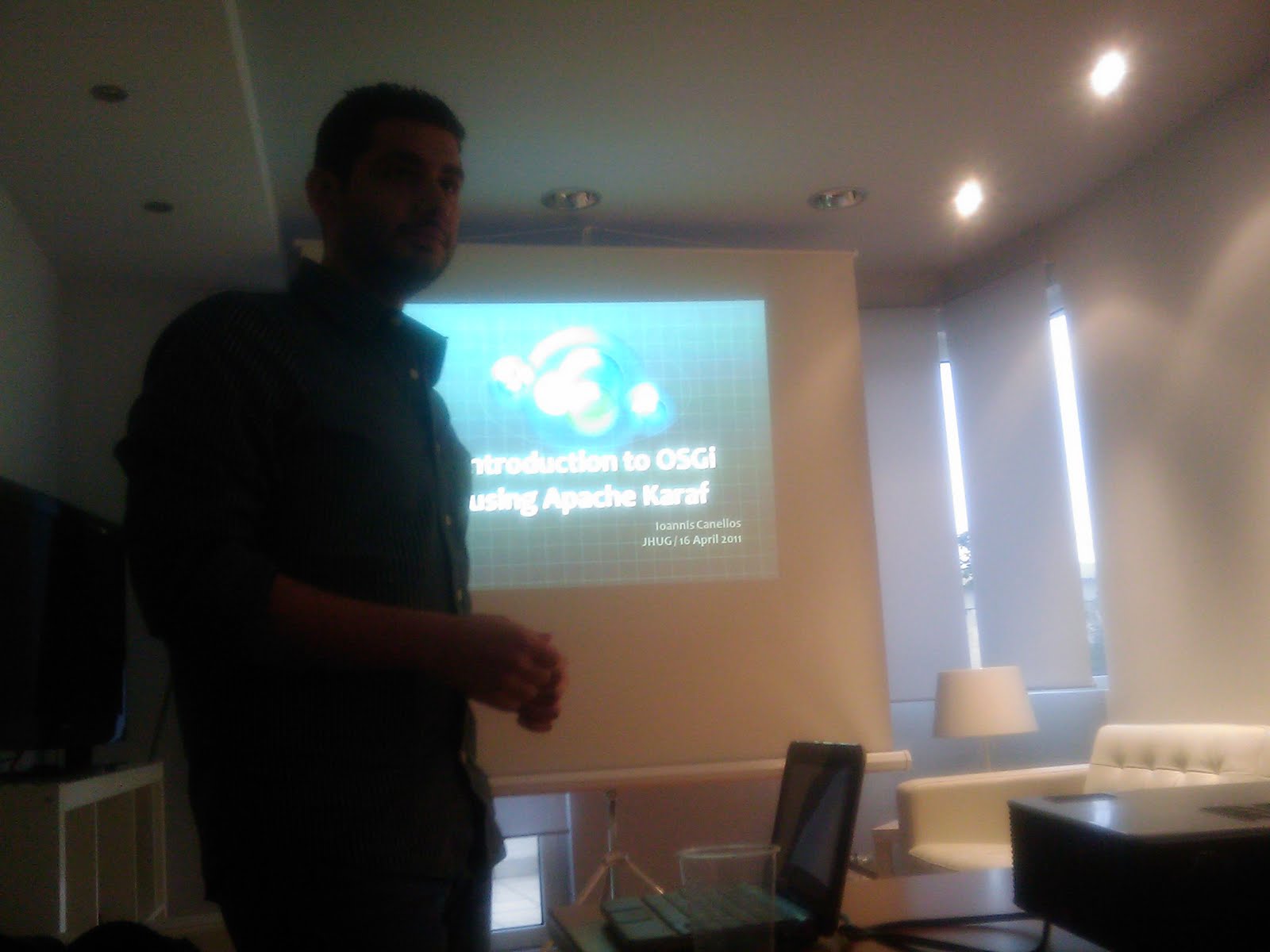
Presented on OSGi and Apache Karaf on Java Hellenic User Group.
It was a great event with very interesting presentations. The full list of presentations can be found here.
Regarding my presentation, I was a bit nervous at first, since I hadn’t practiced my “presentation” skills for a while, but things got better as time went by. I’ve had the chance to meet a lot of interesting people and discuss about OSGi, Apache Karaf & Apache ServiceMix. The slides of the presentation can be found at: Slide Share.
EDIT: The project “cellar” has been upgraded with a lot new features, which are not described by this post. A new post will be added soon.
Prologue
I have been playing a lot with Hazelcast lately, especially pairing it with Karaf. If you haven’t done already you can read my previous post on using Hazelcast on Karaf.
In this post I am going to take things one step further and use Hazelcast to build a simple clustering engine on Karaf.
Prologue
The last months Hazelcast caught my attention. I first saw the JIRA of the camel-hazelcast component, then I read about it, I run some examples and eventually I fell in love with it.
If you are not already familiar with it, Hazelcast is an opensource clustering platform, which provdies a lot of features such as:
- Auto discovery
- Distributed Collection
- Transactions
- Data Partitioning
You can visit the Hazelcast Documentation for more information. In this blog post I will show how to run hazelcast on Apache Karaf or Apache ServiceMix and I will provide an example application that creates a hazelcast instance, deploys the hazelcast monitoring web application and adds a couple of shell commands on Apache Karaf.
1 week after my vacation and still suffering from “post vacation depression”, this Monday seemed like a nightmare.
I went to the office and I was feeling the urge to go get my self a huge Carafe of coffee (cups have long been proven inefficient), when an icoming email draw my attention.
It was an invitation to join Apache Karaf team as a committer.
This is the first open source project I join and I’m very thrilled (if not overreacting) about it and that’s why I decided to blog about it.
EDIT: Hibernate is now OSGi ready so most of those stuff are now completely outdated.
The full source for this post has moved to github under my blog project on branch: wicket-spring-3-jpa2-hibernate-osgi-application-on-apache-karaf.
Prologue
Recently I attempted to modify an existing crud web application for OSGi deployment. During the process I encountered a lot of issues such as
Lack of OSGi bundles. Troubles wiring the tiers of the application together. Issues on the OSGi container configuration. Lack of detailed examples on the web. So, I decided to create such a guide & provide full source for a working example (A very simple person crud application).